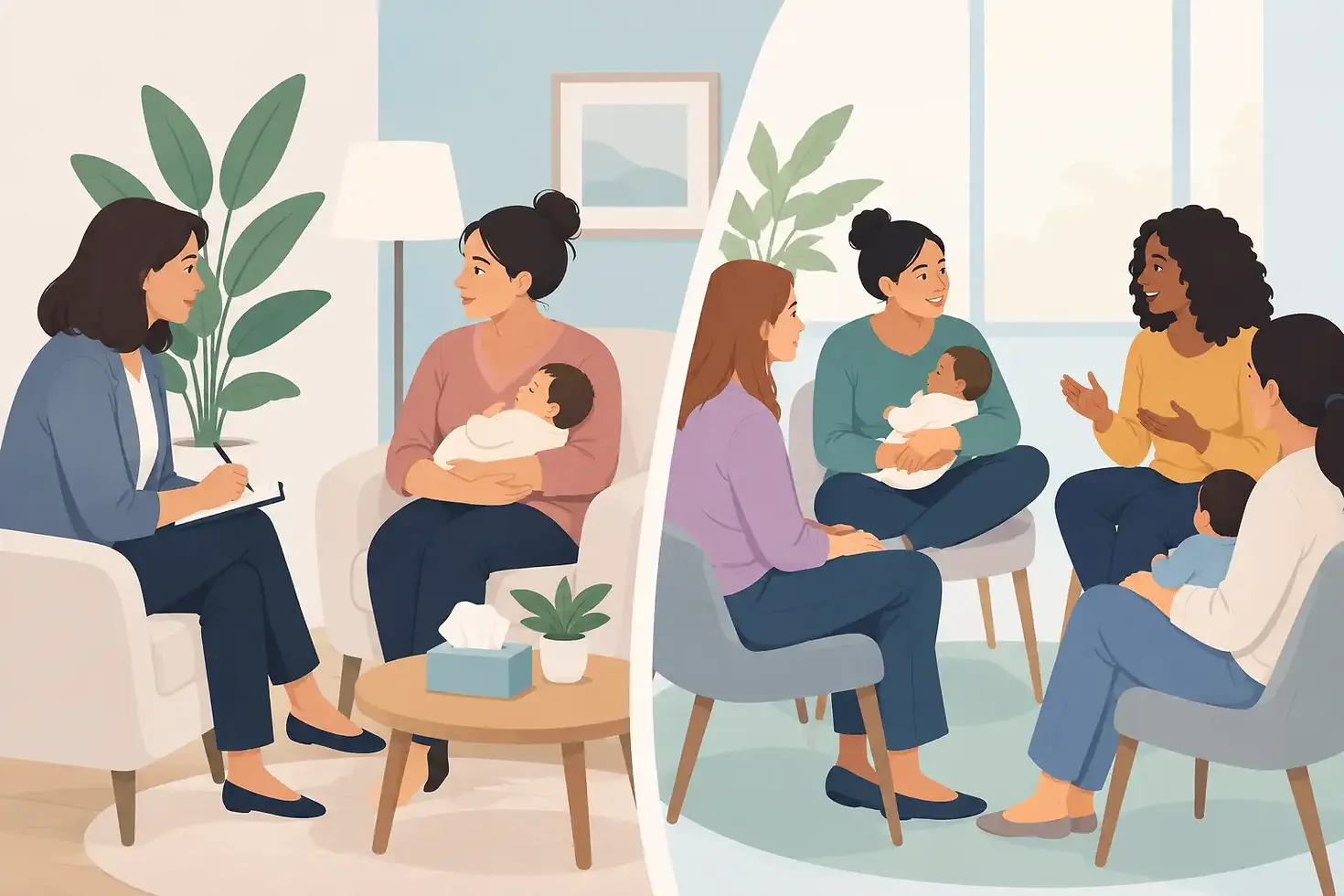
Postpartum Therapy Versus Support Groups Explained
A room full of parents who understand can be deeply relieving. So can sitting with a therapist who has the space, training, and consistency to focus entirely on your story. When weighing postpartum therapy versus support groups, the question is not which option is universally better. It is which kind of support meets you where you are right now.
The postpartum period can hold love, exhaustion, grief, rage, worry, disconnection, and profound change all at once. You do not need to prove that you are struggling enough before reaching for care. Healing starts with having your experience taken seriously.
What postpartum therapy offers
Postpartum therapy is one-on-one mental health care with a licensed clinician. Your therapist works collaboratively with you to understand what you are carrying, what may be affecting your wellbeing, and what support can help. Sessions are confidential, individualized, and shaped around your goals.
For some people, postpartum distress is connected to a difficult birth, pregnancy loss, infertility, a NICU stay, breastfeeding challenges, identity changes, relationship strain, or the sudden weight of being needed around the clock. For others, anxiety, depression, trauma, ADHD, substance use concerns, or past experiences become harder to manage after giving birth. Individual therapy creates room for the full picture rather than asking you to fit your experience into one shared theme.
A trauma-informed therapist does not assume that symptoms are personal failures. They may help you recognize patterns in your nervous system, name what feels unsafe or overwhelming, and practice tools that support regulation and self-trust. Evidence-based approaches can address postpartum depression and anxiety while also making space for the parts of your story that do not fit neatly into a diagnosis.
Therapy may be particularly helpful when your thoughts feel relentless, your mood is affecting daily functioning, or you are carrying painful experiences you do not feel ready to share in a group. It can also provide a private setting to discuss conflict with a partner, shame, resentment, intrusive thoughts, or fears about parenting without worrying about others' reactions.
What postpartum support groups offer
Postpartum support groups bring together people who share a season of life or a common concern. Some are facilitated by a mental health professional, while others are peer-led through community organizations, hospitals, parenting spaces, or online communities. The structure varies widely: one group may center on open conversation, while another may follow a topic such as anxiety, loss, new parent adjustment, or feeding challenges.
Their greatest strength is connection. Hearing another parent say, "I thought I was the only one," can soften isolation and reduce shame. Groups can offer practical ideas, local resources, and the grounding reminder that postpartum adjustment is not meant to be carried alone.
For someone who feels disconnected from friends or family, a consistent group can become a meaningful part of their support network. It may be easier to attend a group than to begin individual therapy, especially when cost, scheduling, childcare, or uncertainty are barriers. Some people find that sharing a little at a time with peers helps them feel more ready for therapy later.
At the same time, a support group usually cannot offer the same level of assessment, confidentiality, crisis planning, or personalized treatment as individual psychotherapy. Even professionally facilitated groups have boundaries around how much attention can be given to each member during a meeting. A peer-led group can be compassionate and valuable without being clinical care.
Postpartum therapy versus support groups: key differences
The clearest difference is the focus. In individual therapy, the time is centered on you, your history, your symptoms, your relationships, and your goals. In a support group, the focus is shared. You receive mutual encouragement, but you also make room for other people's stories and needs.
Privacy is another consideration. Therapy is protected by professional confidentiality, with specific legal and safety-related limits explained by your clinician. Groups often ask members to respect confidentiality, but no facilitator can guarantee what another participant shares outside the room. If you are exploring trauma, relationship violence, substance use, or thoughts that bring up shame, the privacy of therapy may feel more emotionally secure.
The pace is different, too. Therapy can slow down when a subject feels tender and move toward practical skill-building when you need relief now. Groups follow a collective rhythm. That can be stabilizing, but it can also mean a conversation lands differently than you expected or leaves little time to process what came up.
Neither setting needs to be an all-or-nothing choice. Many postpartum parents benefit from both: therapy for individualized healing and a group for belonging. Others begin with one and change course as their needs shift.
How to decide what you need right now
Start by asking a gentle, practical question: do I mostly need to feel less alone, or do I need focused help understanding and changing what is happening for me? The answer can point you toward a group, therapy, or a combination of both.
A support group may be a strong first step if you are looking for community, want to hear from people in a similar stage, and feel able to participate in a shared setting. Look for a group whose purpose and facilitation are clear. You deserve to know whether it is peer-led or clinician-led, whether attendance is ongoing or drop-in, and how the group handles privacy and urgent concerns.
Individual therapy may be the better starting point if your emotions feel intense or persistent, you are avoiding things that once felt manageable, or you need support that is tailored to your circumstances. It can be especially appropriate if birth or parenting experiences have activated past trauma, if you are using alcohol or other substances to cope, or if you feel disconnected from yourself in ways that are frightening.
You might also consider the kind of support you can realistically access. A weekly therapy appointment can offer continuity, while a group may provide more flexible or affordable connection. Virtual options can reduce travel and childcare stress, although some people feel more held by meeting in person. The most effective support is often the support you can return to consistently.
A note about intrusive thoughts and urgent symptoms
Many new parents experience unwanted, upsetting intrusive thoughts. Having a thought does not mean you want to act on it, and shame can make people stay silent when they most need reassurance and care. A trained perinatal mental health professional can help you talk about these thoughts safely and distinguish anxiety-driven intrusions from immediate risk.
If you are concerned you may harm yourself or someone else, are hearing or seeing things others do not, feel severely confused, or cannot sleep for days despite having the chance to rest, seek urgent help right away. Postpartum psychosis is a medical emergency. Call 911, go to the nearest emergency room, or call or text 988 in the United States for immediate crisis support. You deserve prompt care, not judgment.
Choosing support that feels safe
The relationship matters as much as the format. Whether you choose a therapist or a group, pay attention to how your body responds. Do you feel respected? Are your questions welcomed? Is there room for your cultural identity, family structure, values, and lived experience? Support should not ask you to minimize what happened to you or perform gratitude while you are hurting.
You are allowed to try a group and decide it is not the right fit. You are allowed to meet with a therapist and ask about their experience with postpartum concerns, trauma, and evidence-based care. You are also allowed to need more support than a weekly conversation can provide. Reaching for the right level of care is an act of protection for you and your family.
The postpartum version of you does not need to earn care by reaching a breaking point. One honest conversation, one inquiry, or one supportive room can be a beginning. You are not failing because you need support. You are responding to a profound transition with the care and compassion you deserve.



Comments